Cemex CX is a great global infrastructure investment play and it's cheaper now than it has been in the last 10 years based on P/E, P/B and P/CF valuations. The full analysis has been done earlier.
NYSE Euronext NYX has my attention now. Like most of Jim Cramer's stock picks, it is a great company that was "hot" at the time he liked it and now it is definitely not as investors assume that bear market trading volumes will continue FOREVER and also that NYX only receives income from trading (it sells market info amongst other revenue streams). It is acquiring overseas exchanges, most recently a significant portion of the Qatar Bourse. Operating margins are fat at 28%. Valuation is finally compelling with a P/E ratio (trailing) of 14 v.s. industry avg of 26 and P/B of 1.2 (1) and D:E ratio of only 0.05. I'm still doing my homework on this company but I will be sorely tempted by $40/share or less (it was trading at over $100/share one year ago and I calculate a FMV of $80/share). Downside as I see it so far is a relatively modest dividend 1.2%, the complexity of the business is very high and the future cash flows are difficult to predict as they are so levered to the markets.
Thursday, July 10, 2008

Heebner comments about the big picture
N THE HOT SEAT
Portfolio manager casts an optimistic eye on economy
July 6, 2008
Ken Heebner, a portfolio manager at Capital Growth Management in Boston, has delivered some of the best investment performances of any manager in America. He often operates as a contrarian, avoiding technology stocks in the late 1990s and betting early against mortgage companies several years ago. Heebner, 67, spoke last week to Globe reporter Ross Kerber on where the economy is heading.
There's a lot of pessimism about the economy. What's your take?
My view of the world is quite different. I think people are very concerned about our economy, they're starting to realize there could be higher inflation to come. The consensus is that we'll bring the rest of the world into our recession. But my view is we've probably seen the weakest period of economic activity. The economy may not be robust in the next year, but it's seen its low point and at some point will move higher.
That's reassuring, but how can this be?
I understand how serious the housing problem is. But it's not as broad a problem as widely perceived. It's reduced everyone's sense of financial well-being, but a third of homeowners don't have a mortgage, and the vast majority of people made down payments and have fixed-rate mortgages, so there's no financial strain. For them, the only impact is the psychological impact of declining housing prices. So therefore I don't think this is as big a deal as everyone else does. We've passed the point of maximum distress.
What evidence is there for that?
First, on manufacturing, the Institute for Supply Management's index seems to have reached a low of 49, and when this gets to 45, that's a recession. Additionally, the Fed started aggressive ly easing interest rates, and the impact of those eases will start to be felt. But I think the driver of the global economy is the developing countries, with a population of 3 billion. China, Russia, India, Brazil, and a lot of smaller countries. If you add up Japan, Europe, and the US, you're talking about a little less than 1 billion people, and you have 3 billion people going strong.
But those 3 billion have less money and less GDP. How will that drive the world economy?
These people don't have the roads, the airports, the infrastructure - and the building of these creates big demand for industrial raw materials and energy in all forms. In a nutshell, these foreign countries place a high priority on growth. The broad pattern is they're more concerned about maintaining growth than other factors, be it pollution or inflation.
Globe columnist Steven Syre has twice named you fund manager of the year, and Fortune magazine recently dubbed you "America's hottest investor." So can you talk about what you are buying and selling?
The only two stocks I've made references to [owning] in the last few months are Petrobas [Brazil's Petroleo Brasileiro SA] and Schlumberger [an oil-services company]. I'm changing the portfolios so frequently.
What do you expect US growth rates to be? And inflation?
Our economy will surprise us on the upside, growing between 2 to 4 percent over the next 12 months. I'm a bull on the US economy. Clearly housing has been a negative, but there's only four states where they walked housing prices to Never Never Land, and now it's coming back to a realistic level. Because of increasing demand from these developing economies, I can see, three years from now, inflation approaching 10 percent.
How can you be such a bull on the economy and say inflation could be such a potentially big problem?
I didn't say it's a big problem. In the 1970s and 1980s, when inflation was high - we made good money investing in stocks in that period. I'm running a portfolio. I'm not running the country. The challenge inflation presents is that price-to-earnings ratios tend to decline. So when you invest money, you want to have enough growth to offset that compression.
What impact will the outcome of the US elections have on the market?
[Barack] Obama says he wants to eliminate the Bush tax cuts and take the maximum marginal tax rates to 39.6 percent, then institute some Social Security taxes - and says he'll increase the capital gains rate, now 15 percent. That would tend to be a negative factor. It's hard to quantify, but when I think what effect the election could have on the investment world, taxation is where there's a clear difference [between the candidates]. But it would probably be easier for Obama to say, let's drill offshore for oil. That would be a huge benefit to oil-services company stocks. . . . I do think Obama's going to be elected president of the US, and the Democrats [will] win a huge victory in November.
What do you think has been the biggest surprise in the markets this year?
There was a general fear that we would fall into a recession and it hasn't done that. We've gone sideways. The big surprise is that the economy has held up as much as it has. People are overlooking the fact that we're having a huge boom in the farm economy. Also, the energy area is very positive. And I further expect the weak dollar to energize our exports and manufacturing industries. Our natural competitive strengths, our innovation and creativity, remain unique skills in the global economy. We're going to start to export cars, we'll start to export steel.
What are the biggest areas of problems for the US economy?
The brokerage firms were enjoying huge profitability because of the boom in private equity and hedge fund trading, and they won't have that. Higher inflation is always bad for insurance companies, and the banking system still has all the bad mortgage loans eroding its base. It may be a year more of that. They still have a lot more mortgages to write off.
Portfolio manager casts an optimistic eye on economy
July 6, 2008
Ken Heebner, a portfolio manager at Capital Growth Management in Boston, has delivered some of the best investment performances of any manager in America. He often operates as a contrarian, avoiding technology stocks in the late 1990s and betting early against mortgage companies several years ago. Heebner, 67, spoke last week to Globe reporter Ross Kerber on where the economy is heading.
There's a lot of pessimism about the economy. What's your take?
My view of the world is quite different. I think people are very concerned about our economy, they're starting to realize there could be higher inflation to come. The consensus is that we'll bring the rest of the world into our recession. But my view is we've probably seen the weakest period of economic activity. The economy may not be robust in the next year, but it's seen its low point and at some point will move higher.
That's reassuring, but how can this be?
I understand how serious the housing problem is. But it's not as broad a problem as widely perceived. It's reduced everyone's sense of financial well-being, but a third of homeowners don't have a mortgage, and the vast majority of people made down payments and have fixed-rate mortgages, so there's no financial strain. For them, the only impact is the psychological impact of declining housing prices. So therefore I don't think this is as big a deal as everyone else does. We've passed the point of maximum distress.
What evidence is there for that?
First, on manufacturing, the Institute for Supply Management's index seems to have reached a low of 49, and when this gets to 45, that's a recession. Additionally, the Fed started aggressive ly easing interest rates, and the impact of those eases will start to be felt. But I think the driver of the global economy is the developing countries, with a population of 3 billion. China, Russia, India, Brazil, and a lot of smaller countries. If you add up Japan, Europe, and the US, you're talking about a little less than 1 billion people, and you have 3 billion people going strong.
But those 3 billion have less money and less GDP. How will that drive the world economy?
These people don't have the roads, the airports, the infrastructure - and the building of these creates big demand for industrial raw materials and energy in all forms. In a nutshell, these foreign countries place a high priority on growth. The broad pattern is they're more concerned about maintaining growth than other factors, be it pollution or inflation.
Globe columnist Steven Syre has twice named you fund manager of the year, and Fortune magazine recently dubbed you "America's hottest investor." So can you talk about what you are buying and selling?
The only two stocks I've made references to [owning] in the last few months are Petrobas [Brazil's Petroleo Brasileiro SA] and Schlumberger [an oil-services company]. I'm changing the portfolios so frequently.
What do you expect US growth rates to be? And inflation?
Our economy will surprise us on the upside, growing between 2 to 4 percent over the next 12 months. I'm a bull on the US economy. Clearly housing has been a negative, but there's only four states where they walked housing prices to Never Never Land, and now it's coming back to a realistic level. Because of increasing demand from these developing economies, I can see, three years from now, inflation approaching 10 percent.
How can you be such a bull on the economy and say inflation could be such a potentially big problem?
I didn't say it's a big problem. In the 1970s and 1980s, when inflation was high - we made good money investing in stocks in that period. I'm running a portfolio. I'm not running the country. The challenge inflation presents is that price-to-earnings ratios tend to decline. So when you invest money, you want to have enough growth to offset that compression.
What impact will the outcome of the US elections have on the market?
[Barack] Obama says he wants to eliminate the Bush tax cuts and take the maximum marginal tax rates to 39.6 percent, then institute some Social Security taxes - and says he'll increase the capital gains rate, now 15 percent. That would tend to be a negative factor. It's hard to quantify, but when I think what effect the election could have on the investment world, taxation is where there's a clear difference [between the candidates]. But it would probably be easier for Obama to say, let's drill offshore for oil. That would be a huge benefit to oil-services company stocks. . . . I do think Obama's going to be elected president of the US, and the Democrats [will] win a huge victory in November.
What do you think has been the biggest surprise in the markets this year?
There was a general fear that we would fall into a recession and it hasn't done that. We've gone sideways. The big surprise is that the economy has held up as much as it has. People are overlooking the fact that we're having a huge boom in the farm economy. Also, the energy area is very positive. And I further expect the weak dollar to energize our exports and manufacturing industries. Our natural competitive strengths, our innovation and creativity, remain unique skills in the global economy. We're going to start to export cars, we'll start to export steel.
What are the biggest areas of problems for the US economy?
The brokerage firms were enjoying huge profitability because of the boom in private equity and hedge fund trading, and they won't have that. Higher inflation is always bad for insurance companies, and the banking system still has all the bad mortgage loans eroding its base. It may be a year more of that. They still have a lot more mortgages to write off.
Wednesday, July 9, 2008
Sunday, July 6, 2008
New Stock to Study: Alimentation Couche-Tard

Better known as Macs on the west coast or Circle K in the US, ATD is the second largest operator of convenience/gas bar stores in North America. Latest earnings and revenues.
Bull's Take:
- Established brand in a boring, slowly changing industry with largely predictable cash flows that tend not to be as cyclical as other consumer sectors
- 5600 stores but only 20% market share in Canada and 2% in the USA (room to grow but has sufficient economy of scale to warrant a narrow moat)
- Management's track record is excellent: smooth acquisition integration, ROE 18% highest ROC employed of all comps 20%
- Growing rapidly but not too rapidly: EPS increased by average 38%/year over the past 5 years, top line growth 51% increased yoy,
- Company remains highly profitable despite heavy pressure on margins by high gas prices and strong loonie-- if these 2 factors ameliorate a bit, earnings should exceed expectations
- Strong balance sheet with D:E ratio lowest amongst competition at 0.57. Net debt: capitalization 0.39. Well positioned to take advantage of increasingly cheap acquisitions and recent large scale divestments of Big Oil's corner stores/gas bars (Exxon has been doing this already)
- Plans for expansion into Asia under way with a deal for opening franchises in Vietnam signed last quarter
- 20% insider owned-- management and shareholder's interests squarely aligned
- 50 million dollars of shares have recently been "bought back" by the company
- Share price is markedly depressed v.s. historic valuation i.e. mean P/E of 20 now trailing P/E is 14 and FPE is 11
Bear Case:
- minimal dividend
- secondary offers of shares have been dilutive to owner's earnings
- inflation and high fuel prices unlikely to go away anytime soon, if ever
- nuisance lawsuits v.s. the company with anti-competitive allegations seem to be popping up and may fall on sympathetic judicial ears, particularly in Quebec.
DCF calculations using 15% EPS growth for the next 5 years diminishing to 5% thereafter and assuming a 6% return on a risk free alternative investment puts the FMV stock price 5 years out as high as $66/share. I think that a more realistic target would be $25/share within the next 1-2 years.
I don't think that many would argue that at $12.75 today, this company certainly has a generous margin of safety. I would be interested in starting a position at $10/share or less in the current environment, only because I really think that there is a chance the share price could dip that low.
Other than the lack of an acceptable dividend, this company has all the attractive characteristics of a company I would love to own a piece of. Have a look at the AGM investor presentation.
Saturday, July 5, 2008
Forbes Global Value Stocks
See the slide show here.
LYG, AIG and AXP reviewed earlier in this blog. As the market carnage continues, I hope to add to all three positions as well to UNH which is dropping down to it's book value rapidly.
I'm putting together a virtual mutual fund on Marketocracy.com with to use as an educational model for a million dollar portfolio of value stocks, using the principles discussed in this blog. The ticker is VCI and the name of the fund is the Victoria Contrarian Investor's Fund. When I have it up and running, I'll post a link. Marketocracy offers a free registration and is an amazing resource of investment ideas for all investors, regardless of their style of preference. They take the top performing investor's ideas and distill them into a mutual fund that you can actually invest in, to boot.
l
LYG, AIG and AXP reviewed earlier in this blog. As the market carnage continues, I hope to add to all three positions as well to UNH which is dropping down to it's book value rapidly.
I'm putting together a virtual mutual fund on Marketocracy.com with to use as an educational model for a million dollar portfolio of value stocks, using the principles discussed in this blog. The ticker is VCI and the name of the fund is the Victoria Contrarian Investor's Fund. When I have it up and running, I'll post a link. Marketocracy offers a free registration and is an amazing resource of investment ideas for all investors, regardless of their style of preference. They take the top performing investor's ideas and distill them into a mutual fund that you can actually invest in, to boot.
l
Wednesday, July 2, 2008
Michael Dell
I usually watch insider trading with a somewhat detached interest but 2 recent huge trades have caught my attention:
--Michael Dell, founder and current CEO of Dell computer bought 4.5 MILLION shares at $22/share yesterday (about 100 MILLION dollars worth).
--An officer (from a well known investment co in the US as well) of the board of directors at Home Depot bought $30 million of common stock.
These aren't stock options, these are shares bought on the open market with their own pocket change just like you and I.
The significance of these trades remains to be seen; however, even to a billionaire these purchases show conviction from folks who know the business better than almost anyone else.
l
Tuesday, July 1, 2008
How to fight bear-handed
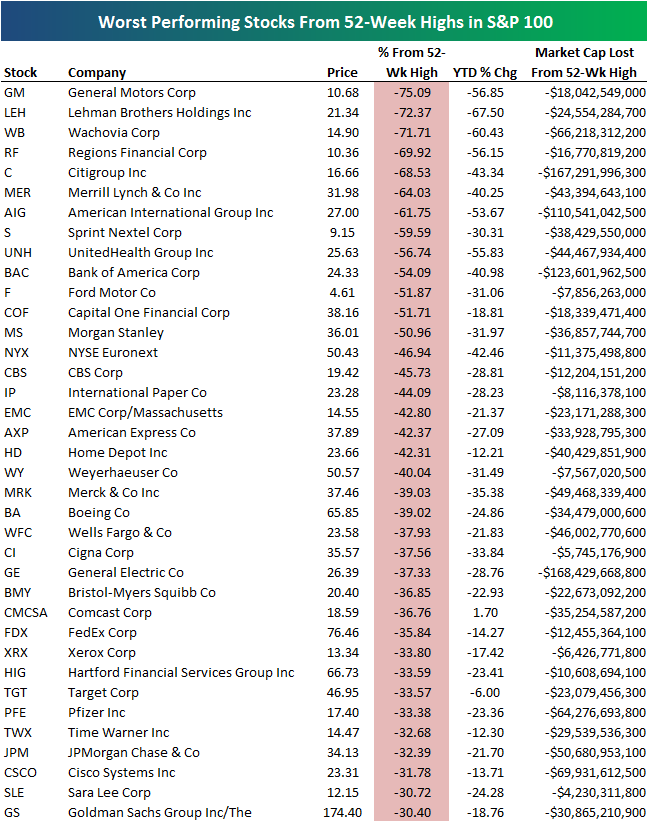
 ****Click on the chart above to expand it....*****
Brutal, eh? Almost anyone could recognize the household names in the chart above. They are all "blue chip" stocks that brokers are supposed to be selling to orphans and widows because they are supposedly safe investments with potential for slow but sure capital appreciation combined by decent dividend yields to provide a little income. They all have large market capitalizations and many are multi-national and have wide economic moats to protect them. What's happened?
Many sane and calm-headed investors are now calling this the worst recession the USA (the world to follow) has seen since the Great Depression, mostly because of 3 negative economic forces striking simultaneously: the great deleveraging from the credit market collapse, the impressive rise in the cost of energy and food, plus the emergence of double digit inflation in most developing nations that had been (up to recently) driving global trade and economic growth. The outcome of these complex and interrelated problems cannot be predicted although it's fun to guess. I suspect that your thoughts about this have as much merit as the most erudite economist-- their track record for prediction of the start and end of bear markets is MUCH worse than a coin flip. It's not that economists are stupid or corrupt, it's just very, very hard to do and my point is: don't even try. Or if you do, just do it for fun and realize that you are participating in an intellectual exercise. Whatever you do, NEVER invest based on a gut feeling about the economic environment and where it is going. Even worse NEVER borrow money and use margin to buy based on that hunch. That's gambling and the house will win 7/10 times. The worst thing that can happen is that you will be correct and think you are a genius--- then the market will crush you.
"The market can remain irrational much longer than you can remain solvent."
John Maynard Keynes
Instead buy equities that have:
Two of my previous picks, Georgia Gulf Corp and Popular may crumble because of increasingly weak balance sheets and poor short term prospects. (as an aside, I have divested my shares in GCC and I have decided to hold on to BPOP because the dividend is continuing to be paid (how much longer?) and I suspect that the company's regional virtual monopoly in PR along with latino customer loyalty may sustain it to emerge virtually competitor-free.
Clarke CKI, is a favourite small cap private equity holding of mine although I have become increasingly concerned lately by the management's spending spree: they've taken Art in Motion private and bought large stakes in several other trusts as well as Liquidation World. These all may well prove to be great long term investments, particularly for such skilled catalyst/activists as the Armoyan crew. HOWEVER, the balance sheet is deteriorating and I don't like that. Over $40 million in cash has been converted to investments with poor short term prospects (particularly the market value of those investments) and as of Q1 2008 Clarke only had 2 million dollars of cash. Since that time CKI has offered to buy back $6.5 million of its outstanding 29 million common shares.... after buying sizable amounts of LW, Amisco and AIM units/shares! The only way they could achieve all of these transactions is to take on yet more debt and I calculate the D:E ratio is sitting close to 1 today. I'm not certain that depleting the cash cushion in current market conditions is prudent and I am considering paring back my position. I am reluctant to do so because I like the business plan very much. At $6.55/share CKI is trading at least 10% discount to NAV/book value; however, I feel that margin of safety for the investment has deteriorated significantly and if economic conditions on both sides of the border go even further downhill, I'm worried that little CKI will not survive.
On the other hand, Clarke Inc's big brother Onex Corp OCX is going exactly the opposite direction. It is aggressively increasing capital. Like Brookfield Asset Management (another favourite), OCX's risk management is quite clever: it uses non-recourse clauses in its financing to protect the parent holding company while positioning itself to take advantage of its markedly financially weakened targets. More on Onex in my next post....
l
Disclosure: My wife will be placing a bid for OCX shares at $29 soon.
- proven management that can execute a simple, easy to understand business plan (and have a track record at least 5 years long)
- preferably in a slowly changing industry with predictable cash flows
- have a strong balance sheet with lots of cash and little or manageable debt
- strong free cash flows (Buffett's "owner's earnings")
- a sustainable dividend that matches or exceeds the inflation rate to protect the real return of your investment
- a wide economic moat so that when the bear market blows over (whenever it does) the business emerges well positioned to take even more market share from its much diminished competitors
Two of my previous picks, Georgia Gulf Corp and Popular may crumble because of increasingly weak balance sheets and poor short term prospects. (as an aside, I have divested my shares in GCC and I have decided to hold on to BPOP because the dividend is continuing to be paid (how much longer?) and I suspect that the company's regional virtual monopoly in PR along with latino customer loyalty may sustain it to emerge virtually competitor-free.
Clarke CKI, is a favourite small cap private equity holding of mine although I have become increasingly concerned lately by the management's spending spree: they've taken Art in Motion private and bought large stakes in several other trusts as well as Liquidation World. These all may well prove to be great long term investments, particularly for such skilled catalyst/activists as the Armoyan crew. HOWEVER, the balance sheet is deteriorating and I don't like that. Over $40 million in cash has been converted to investments with poor short term prospects (particularly the market value of those investments) and as of Q1 2008 Clarke only had 2 million dollars of cash. Since that time CKI has offered to buy back $6.5 million of its outstanding 29 million common shares.... after buying sizable amounts of LW, Amisco and AIM units/shares! The only way they could achieve all of these transactions is to take on yet more debt and I calculate the D:E ratio is sitting close to 1 today. I'm not certain that depleting the cash cushion in current market conditions is prudent and I am considering paring back my position. I am reluctant to do so because I like the business plan very much. At $6.55/share CKI is trading at least 10% discount to NAV/book value; however, I feel that margin of safety for the investment has deteriorated significantly and if economic conditions on both sides of the border go even further downhill, I'm worried that little CKI will not survive.
On the other hand, Clarke Inc's big brother Onex Corp OCX is going exactly the opposite direction. It is aggressively increasing capital. Like Brookfield Asset Management (another favourite), OCX's risk management is quite clever: it uses non-recourse clauses in its financing to protect the parent holding company while positioning itself to take advantage of its markedly financially weakened targets. More on Onex in my next post....
l
Disclosure: My wife will be placing a bid for OCX shares at $29 soon.
Subscribe to:
Posts (Atom)

 Posts
Posts

